Understanding Soil Bearing Capacity: How It Affects Your Foundation Design
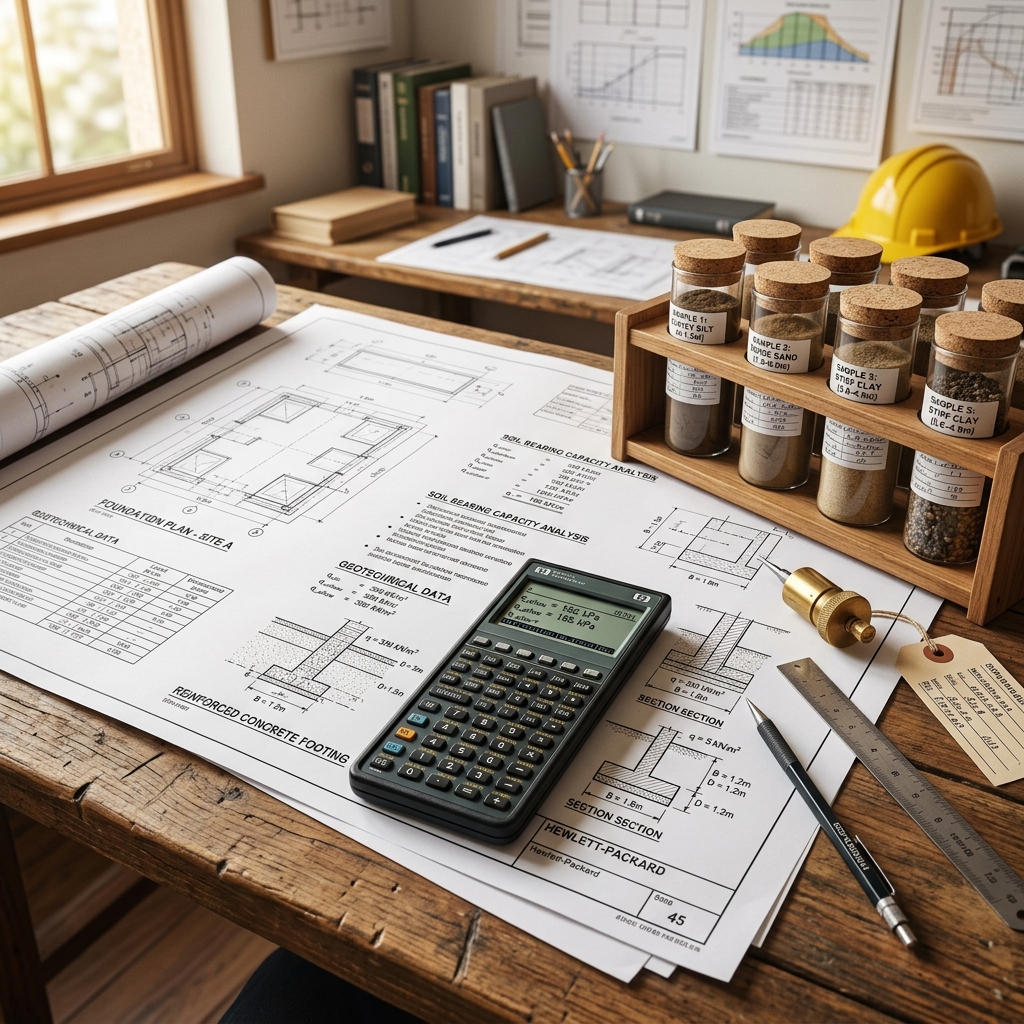
Every structure — whether it's a modest two-storey home or a multi-storeyed commercial tower — puts enormous weight on the ground below it. How that weight is carried, spread, and resisted depends almost entirely on one critical parameter: soil bearing capacity.
It's a term you'll hear constantly in geotechnical engineering, but it's one that's often misunderstood — or worse, glossed over — even by experienced builders and contractors. The truth is, if you're designing a foundation without a proper understanding of soil bearing capacity, you're essentially making an educated guess about whether your structure will stand safely for decades.
In this blog, we break down exactly what soil bearing capacity is, how it's determined, how it directly influences your foundation design, and what happens when it's ignored.
What Is Soil Bearing Capacity?
Soil bearing capacity is the ability of a soil to safely support the loads applied to it by a foundation without undergoing shear failure or excessive settlement. In other words — how much load can the ground handle before it gives way?
There are two key values every geotechnical engineer works with:
Ultimate Bearing Capacity (qᵤₗₜ)
This is the maximum load per unit area that the soil can carry before it completely fails — meaning the ground literally shears and the foundation sinks uncontrollably. This is a theoretical upper limit and is never used directly for design.
Safe Bearing Capacity of Soil (qₛ)
This is the value engineers actually use for foundation design. The safe bearing capacity of soil is derived by dividing the ultimate bearing capacity by a Factor of Safety (typically 2.5 to 3.0) and then further reducing it to ensure that settlement stays within acceptable limits.
Safe Bearing Capacity = (Ultimate Bearing Capacity ÷ Factor of Safety), adjusted for permissible settlement.
This is the number your structural engineer needs before they can design a single footing.
Types of Bearing Capacity Failure
Understanding how soil fails helps you appreciate why getting this number right matters so much. There are three classic failure modes:
- 1. General Shear Failure: This is the most dramatic type — the soil suddenly and completely fails along a well-defined failure surface. It typically occurs in dense sands and stiff clays, and gives a clear, sudden collapse. Foundations in these soils must be designed well within the safe bearing capacity to prevent this.
- 2. Local Shear Failure: In medium-density soils, the failure surface doesn't fully develop. Instead, you get significant compression and bulging of soil on the sides of the foundation before collapse. There's a warning before failure, but that's cold comfort if you haven't designed for it.
- 3. Punching Shear Failure: This occurs in loose, soft soils. The foundation simply punches into the ground, with little lateral displacement. It's slow and progressive, but buildings can end up severely tilted or partially sunken before anyone realises what's happening.
What Factors Affect Soil Bearing Capacity?
Soil bearing capacity isn't a fixed property — it varies based on a combination of factors that only a thorough geotechnical investigation can reveal. These include:
- Soil Type and Classification: Dense gravels and well-compacted sands have very high bearing capacities. Soft clays, silts, and loose fills can have extremely low bearing capacities.
- Depth of Foundation: As a general rule, the deeper the foundation, the higher the bearing capacity. This is because soil becomes denser and more confined with depth.
- Groundwater Table: The presence of water in the soil has a significant negative effect on bearing capacity. In some cases, a high water table can reduce the safe bearing capacity by up to 50%.
- Width and Shape of the Foundation: A wider foundation spreads the load over a larger area. The shape (square, rectangular, circular) also affects load distribution.
- Shear Strength Parameters: Cohesion (c) and angle of internal friction (φ) obtained from laboratory tests are the primary factors used in formulas like Terzaghi's and Meyerhof's.
Typical Safe Bearing Capacity Values for Common Soil Types
While these are general indicative values, they give you a useful reference point. Always use site-specific investigation data for actual foundation design.
| Soil Type | Typical SBC (kN/m²) | Foundation Suitability |
|---|---|---|
| Soft Clay / Silt | 50 – 100 | Poor – Needs piles or raft |
| Firm Clay | 100 – 200 | Moderate – Raft or shallow footing |
| Loose Sand | 100 – 150 | Low – Compaction may be needed |
| Medium Dense Sand | 150 – 300 | Good – Isolated or strip footings |
| Dense Sand / Gravel | 300 – 600 | Very Good – Most foundation types |
| Stiff Clay | 200 – 400 | Good – Shallow or deep footings |
| Hard Rock / Granite | 1500 – 3000+ | Excellent – Any foundation type |
Note: These values are indicative only. Actual safe bearing capacity must be determined through proper field and laboratory testing as per IS 1904 and IS 6403.
How Is Safe Bearing Capacity Determined?
- Standard Penetration Test (SPT): The most widely used field test in India. N-values are correlated to bearing capacity using IS 2131 guidelines.
- Plate Load Test: Gives a direct measurement of the load-settlement behaviour of the soil in the field.
- Laboratory Shear Strength Tests: Tests like Triaxial Compression or Direct Shear determine cohesion and friction angle to compute capacity using Terzaghi's equations.
- Static Cone Penetration Test (SCPT): Gives a detailed, continuous soil profile, particularly useful in soft/loose soils.
How Soil Bearing Capacity Directly Affects Foundation Design
The safe bearing capacity of soil essentially dictates which type of foundation you can use.
- High SBC (above 200 kN/m²) → Isolated or Strip Footings: Foundation can remain relatively shallow and cost-effective.
- Moderate SBC (100–200 kN/m²) → Raft Foundation: Spreads load over a large slab when individual footings overlap or soil is variable.
- Low SBC (below 100 kN/m²) → Deep Pile Foundations: Load must be transferred to deeper, stronger soil or rock layers.
- Problematic Soils → Specialist Foundations: Black cotton soils may necessitate under-reamed pile foundations.
The Settlement Problem: It's Not Just About Failure
Even when a soil won't shear, it may still settle. Uniform settlement is often acceptable, but differential settlement causes cracking and distortion. A site investigation report predicts how much soil will compress to ensure it stays within permissible limits (e.g., 25 mm for isolated footings, 40 mm for rafts per IS 1904).
Build On Knowledge, Not Assumptions
Soil bearing capacity is the foundation of your foundation design. Get it right, and your structure will stand safely for generations. Get it wrong, and no amount of good construction above ground will save you.
Need a Soil Investigation Report for Your Project?
Contact Terratech Engineers for a thorough geotechnical investigation and safe bearing capacity analysis tailored to your specific site. Our experienced team delivers accurate, IS-code-compliant reports that give your project the solid foundation it deserves.
www.terratechengineers.in | Ghaziabad, Uttar Pradesh, India