What is SPT Test? Procedure, Equipment & Importance
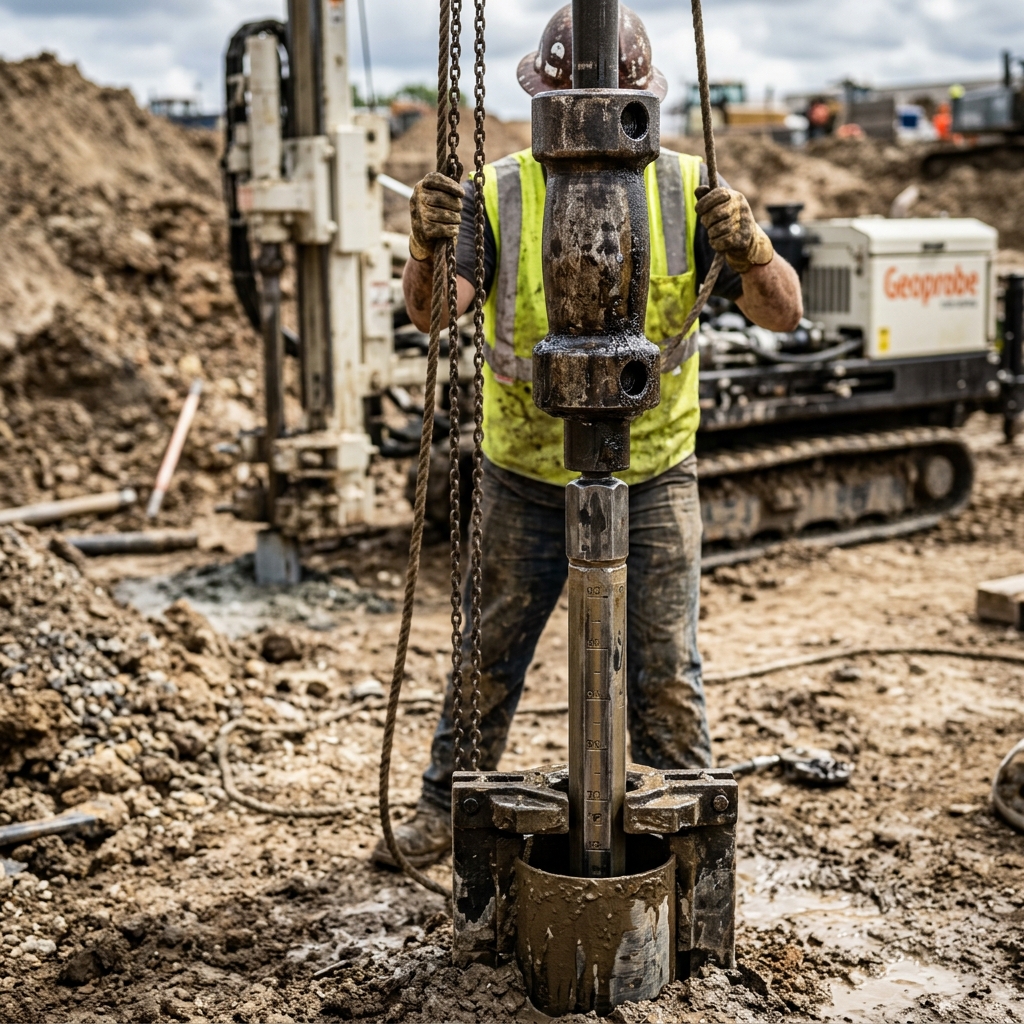
The Standard Penetration Test (SPT) is undoubtedly the most widely utilized in-situ test anywhere in the globe, serving as the cornerstone of Geotechnical Investigation. It provides a reliable indication of relative density of granular soils and consistency of cohesive soils.
Understanding the SPT N-Value
The core philosophy of SPT revolves around the "N-Value". Simply put, it is the number of hammer blows required to drive a standard split-spoon sampler 300 mm (12 inches) into the soil. This empirical value helps civil engineers compute absolute bearing capacity and predict settlement for foundations.
Equipment Required
The test utilizes specialized equipment formulated strictly according to established standards such as IS 2131:
- Split-Spoon Sampler: An open-ended steel tube split longitudinally.
- Drop Hammer: Usually weighing 63.5 kg (140 lbs).
- Guide Pipe & Drill Rods: For ensuring the hammer drops exactly 75 cm (30 inches).
- Drilling Rig: To prepare the borehole and lower the sampler efficiently.
Procedure Step-by-Step
1. Drilling the Borehole
First, a borehole is drilled to the required depth, and the drill completely cleans the bottom of the bore. It is imperative that undisturbed soil conditions are replicated as closely as possible.
2. Driving the Sampler
The split-spoon sampler is attached to the drill rod and lowered into the borehole. The 63.5 kg hammer is repeatedly dropped from a height of 750 mm. The test operates in three successive 150 mm stages (totaling 450 mm). The blows recorded for the first 150 mm are known as seating drive and are discarded. The sum of the blows for the second and third 150 mm intervals constitutes the standard penetration resistance, or the N-value.
Why the SPT Test is Crucial
Obtaining precise soil strata profiles through tests like the SPT is not just regulatory—it's vital. Just like our high-precision DGPS Survey provides exact topographical mapping, the SPT gives structural engineers a "sub-surface map" of bearing limitations.
Frequently Asked Questions (FAQ)
What does an N-value of 15 mean?
An N-value of 15 in sandy soils signifies medium density. It can typically support a standard shallow foundation properly designed to handle projected multi-story loads.
Is SPT reliable in clayey soils?
While mostly reliable for cohesionless sandy/gravelly soils, the SPT gives a reasonable estimation of unconfined compressive strength for stiff clays, though specialized Geotechnical Investigation using CPT or Shelby tubes yields far better results for soft clays.