Plate Load Test: Complete Guide with Formula & Uses
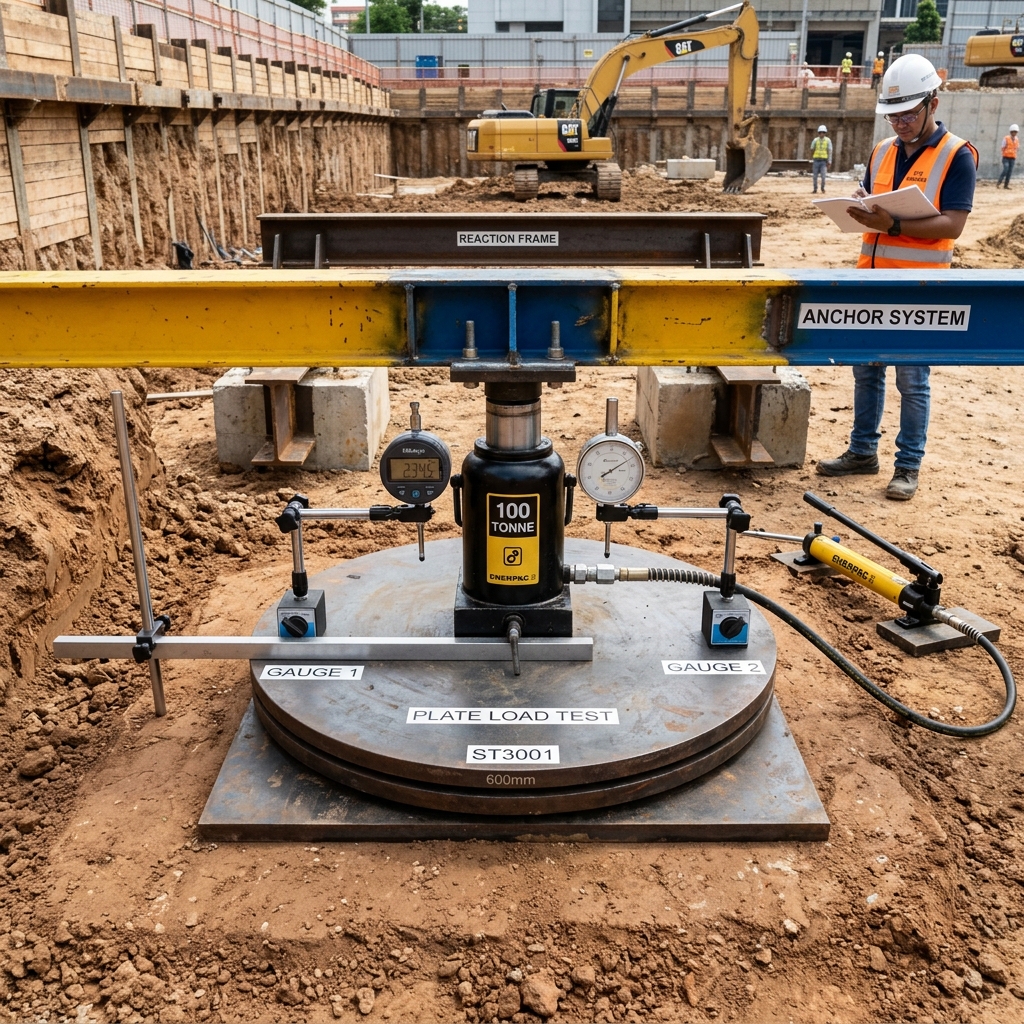
The Plate Load Test is an essential field test in Geotechnical Investigation used to directly assess the bearing capacity and estimated settlement of soil under given load characteristics. By putting actual stress on a limited soil footprint, engineers simulate the behavior of a building foundation on a scaled level.
Why is the Plate Load Test Important?
Different structures transfer load differently. In conjunction with our high-end DGPS Survey, the Plate Load Test maps the subterranean conditions accurately. The primary goals are determining the allowable bearing pressure and predicting settlement for a particular load increment.
Equipment Breakdown
Setup is rigorous and demands proper calibration:
- Bearing Plate: Made of mild steel, usually 300 mm to 750 mm in size, and not less than 25 mm thick.
- Hydraulic Jack: Used to provide the loading increments.
- Reaction System: Either gravity loading (kentledge) or a truss anchored deep into the ground.
- Dial Gauges: Positioned around the plate to measure the subsequent exact settlement up to a fraction of a millimeter.
Test Procedure
1. Pit Preparation
A test pit is dug to the proposed level of the foundation base. The pit must be large enough to eliminate side friction, normally spanning five times the width of the test plate.
2. Applying Loads
The loading is applied on the plate progressively. Typical stages include 1/5th of the expected safe bearing capacity until the soil fails or the structure hits its ultimate threshold. After each increment, the settlement displayed on the dial gauges is logged. The results generate a highly accurate load-settlement curve.
Formula for Bearing Capacity
Usually, the data allows for interpolation directly off the constructed load-settlement graph for cohesive soils, but formulas must compensate for scale when applied to sandy elements.
In sandy soils, an approximation derived is:
Sf / Sp = [ B / bp ] × [ (bp + 0.3) / (B + 0.3) ]²
Where Sf and Sp are settlements of foundation and plate respectively. B is the width of foundation and bp is the width of test plate.
Frequently Asked Questions (FAQ)
How long does a plate load test take?
The duration varies significantly depending on the soil type. For granular soils, settlement occurs fast, and tests can conclude in a few hours. For clays, consolidation can take 24 to 72 hours.
Is the Plate Load Test accurate for deeper layers?
No, this is its main limitation. The stress created by the loaded plate is significant only up to a depth equivalent to twice the plate's width. For deeper data profiling, supplementary Geotechnical Investigation using boreholes is absolutely necessary.