How GPS and Total Station Technology Is Revolutionising Land Surveying
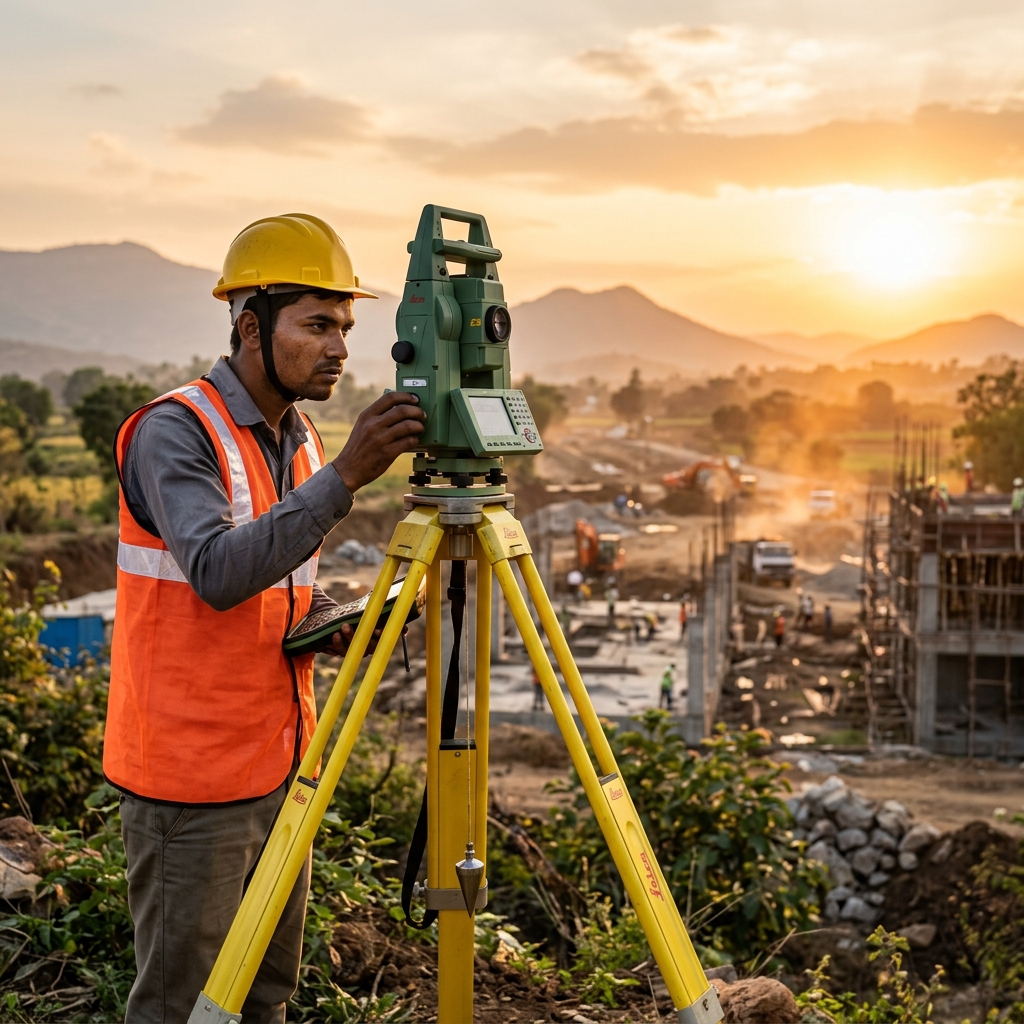
Not too long ago, a land survey meant a team of surveyors spending days in the field with chains, ranging rods, and theodolites, manually recording measurements and painstakingly drafting plans by hand. Errors were common. Re-surveys were expensive. And large projects could take weeks just to gather enough field data to begin design.
That world has changed dramatically. Modern land surveying methods have transformed the profession — making surveys faster, more accurate, more reliable, and richer in data than ever before. At the forefront of this transformation are two technologies: GPS/GNSS and Total Station instruments.
Why Technology Matters in Land Surveying
A survey is the foundation of almost everything that follows in a construction or development project. The site layout, the legal boundary documentation, the drainage design, the earthwork calculations, the foundation plan — all of it is built on the coordinates and elevations captured during the survey. If those numbers are wrong, everything built on top of them is wrong.
Modern GPS surveying technology and digital Total Station instruments eliminate most traditional error sources, delivering sub-centimetre accuracy as a routine outcome rather than an exceptional one.
GPS Surveying Technology: How It Works and Why It's a Game-Changer
GPS is one component of a broader family of satellite navigation systems collectively known as GNSS — Global Navigation Satellite Systems. In India, modern surveying equipment receives signals from multiple satellite constellations simultaneously, including the US GPS system, Russia's GLONASS, Europe's Galileo, and India's own regional system, NavIC.
Differential GPS (DGPS)
A fixed reference station at a known location transmits correction signals to the rover (the handheld unit carried across the survey site). By comparing what the reference station 'sees' from the satellites versus what it knows its position to be, it generates corrections that improve rover accuracy to 1–3 metres for standard DGPS, and to centimetre level for more advanced techniques.
Real-Time Kinematic (RTK) GPS
RTK is the gold standard for modern field surveying. A base station is set up at a known or newly established control point. It transmits phase correction data in real time via radio or cellular link to the RTK rover. The rover processes these corrections on the fly, achieving horizontal accuracy of ±1–2 cm and vertical accuracy of ±2–3 cm — in real time, in the field.
Network RTK and CORS
In more advanced setups — increasingly available in urban India — surveyors connect to Continuously Operating Reference Station (CORS) networks via the internet, eliminating the need to set up a base station altogether.
Key Advantages of GPS Surveying Technology
- Speed — a skilled GPS surveyor can capture hundreds or thousands of points per day
- Accuracy — centimetre-level precision as standard, not the exception
- No line of sight required — ideal for large open sites
- 3D data — GPS captures horizontal position AND elevation simultaneously
- Direct digital output — data goes straight from receiver to a digital field book
- Real-time quality checks — the surveyor can see immediately if a point has been captured to the required accuracy
Total Station Survey: Precision for Complex and Confined Sites
While GPS has transformed open-field surveying, there are many situations where GPS signals are unavailable or unreliable: dense urban areas, under tree canopy, inside buildings, in narrow cuttings, in underground works. This is where the Total Station survey remains absolutely essential.
A Total Station is an electronic optical instrument that combines three functions in a single device:
- Electronic Theodolite — measures horizontal and vertical angles with arc-second precision
- Electronic Distance Meter (EDM) — measures distances to a target prism, typically to within ±1–2 mm
- On-board Computer — processes angles and distances to calculate 3D coordinates of each measured point
Robotic Total Station
Modern robotic Total Stations can automatically track and follow a moving prism without the surveyor needing to stay at the instrument. A single surveyor can operate the entire setup remotely from their rover pole.
Reflectorless Total Station
For measuring points that are difficult or impossible to physically reach — cliff faces, building facades, bridge soffit, top of a wall — modern Total Stations can measure distances without a reflector prism, using a laser spot targeted directly at the surface.
GPS vs. Total Station: When to Use Which
| Situation | GPS / GNSS RTK | Total Station |
|---|---|---|
| Large open site (farmland, greenfield) | ✔ Preferred | Works but slower |
| Dense urban / built-up area | Signal blocked | ✔ Preferred |
| Under tree canopy | Reduced accuracy | ✔ Preferred |
| Topographic survey | ✔ Excellent for open sites | ✔ Good for complex terrain |
| Setting out (construction layout) | Usable if signal strong | ✔ Preferred (higher precision) |
| Boundary survey in city | May be affected by buildings | ✔ Preferred |
| Large infrastructure corridor | ✔ Excellent | Used for detail points |
| As-built survey of existing structure | Limited | ✔ Preferred (reflectorless) |
In practice, most professional surveying firms — including Terratech Engineers — use both technologies in combination, choosing the right tool for each part of the job.
Drone Surveying: The Next Frontier
Beyond GPS and Total Station, the latest addition to the modern surveying toolkit is drone-based photogrammetry and LiDAR. A drone equipped with a calibrated camera and a GPS receiver can fly over a site and capture thousands of overlapping aerial photographs. For a 10-hectare site, a drone survey can capture enough data in 30–60 minutes for a team to process into a survey plan that traditionally would have taken several days.
What This Means for Your Project
- Faster turnaround — surveys that previously took a week can be done in a day or two
- Higher accuracy — sub-centimetre precision as standard, reducing design errors and re-work
- Digital deliverables — DXF/DWG files ready for your architect or engineer
- Better documentation — full digital audit trails of every measurement taken
- Scalability — the same methods apply whether surveying a 200 sq metre plot or a 2,000-hectare corridor
Commission Your Survey with Terratech Engineers
Want a fast, accurate, technology-powered land survey for your project? Contact Terratech Engineers today. We'll assess your requirements and deploy the right combination of GPS, Total Station, and drone survey technology to deliver the precise data your project needs.
www.terratechengineers.in | Ghaziabad, Uttar Pradesh, India