5 Warning Signs of Slope Instability and How to Prevent Landslides
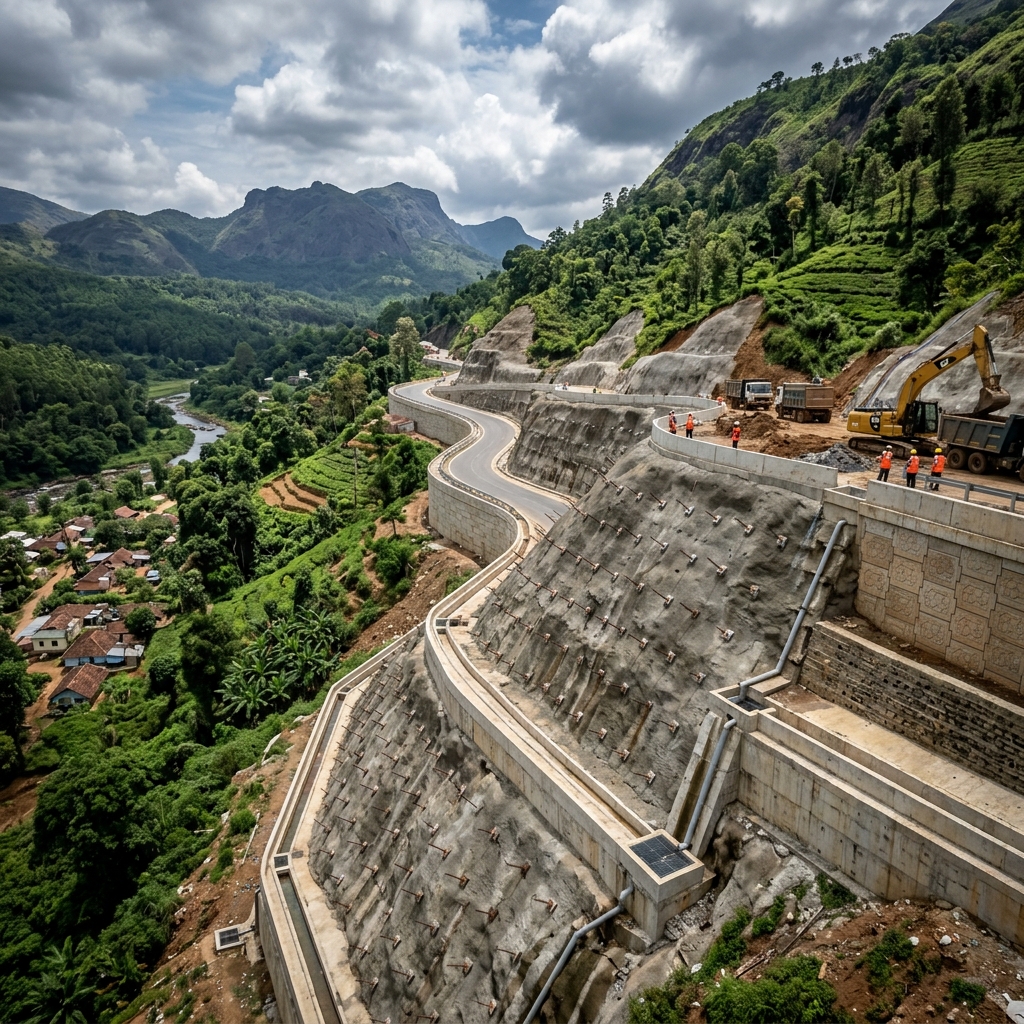
Slopes — whether natural hillsides, earthen embankments, highway cuttings, or engineered fill slopes — are not as static as they look. Under the right conditions, any slope can fail. And when it does, the consequences can be catastrophic: roads blocked, buildings destroyed, lives lost, and infrastructure projects set back by months or years.
Landslides are one of the most destructive geohazards affecting India. From the fragile Himalayan terrain in Uttarakhand and Himachal Pradesh to the Western Ghats and the hilly regions of the North-East, slope instability claims lives and causes hundreds of crores in damage every year. But here's what many people don't realise: most slope failures don't happen without warning. There are signs — if you know what to look for.
In this blog, Terratech Engineers walks you through the 5 most critical warning signs of slope instability, the underlying slope failure causes, and the slope stability analysis and engineering solutions that can prevent disaster.
What Is Slope Instability — and Why Does It Happen?
A slope is stable when the forces resisting movement — primarily the shear strength of the soil or rock — are greater than the forces driving movement (gravity, water pressure, surcharge loads). Slope instability occurs when this balance tips: when driving forces exceed resisting forces, the slope moves.
This tipping point can be triggered by a single event — a heavy monsoon, an earthquake, or a blast from a nearby construction site — or by a slow, progressive weakening of the slope over months and years. In either case, the slope failure causes are almost always rooted in one or more of the following:
- Increase in pore water pressure due to heavy rainfall or groundwater rise
- Loss of vegetation cover that previously anchored the soil
- Undercutting of the slope toe by erosion, river action, or construction excavation
- Addition of surcharge loads at the crest (construction, stockpiling, overburden)
- Earthquake-induced ground shaking that momentarily reduces shear strength
- Weathering and deterioration of rock joints and clay seams over time
Warning Sign #1: Tension Cracks at the Top of the Slope
If you notice cracks running roughly parallel to the slope crest — sometimes called tension cracks or head scarps — treat them as a serious red flag. These cracks form when the upper portion of the slope begins to pull away from the stable ground behind it.
They are typically the first visible evidence of incipient slope movement. In many documented landslide events across India, tension cracks appeared days or even weeks before the main failure — providing a window for intervention that was unfortunately missed.
What to look for:
- Cracks running horizontally or in a curved arc near the slope crest
- Cracks that are wider at the surface and narrow downward (indicating tension, not simple drying)
- Progressive widening of cracks over days or weeks — this is particularly alarming
- Cracks on roads, walls, or structures near the slope crest
What to do: Commission an immediate slope stability analysis. Do not allow further loading at the slope crest. Restrict access to the area. Monitor crack width with pegs and document daily.
Warning Sign #2: Bulging or Heaving at the Slope Toe
While tension cracks form at the top of a failing slope, the bottom of the slope tells its own story. When a slope is on the verge of failure, the soil mass trying to move downward must go somewhere — and that somewhere is often outward at the toe.
A bulge or heave at the base of a slope is one of the most reliable indicators that a slope failure is in progress or imminent.
What to look for:
- A rounded, swollen-looking protrusion at the base of the slope
- Ground surface at the slope toe that appears raised or pushed outward
- Cracking of roads or pavements at the base of the slope, particularly in a curved pattern
- Damage to retaining structures, boundary walls, or drainage channels at the toe
- Soft, spongy ground at the slope base that wasn't there before
What to do: This is an advanced warning sign — failure may be imminent. Evacuate the area and call a geotechnical engineer for an emergency slope stability assessment.
Warning Sign #3: Changes in Drainage Patterns and Springs
Water is the single biggest driver of slope instability. Any change in how water moves through or over a slope should be taken seriously. The relationship between water and slope failure causes is so strong that in geotechnical engineering, it is said: "most slope failures are water failures."
What to look for:
- New springs or seepage points appearing on the slope face
- Changes in the colour of seeping water — turbid or muddy seepage indicates internal erosion (piping)
- Surface drainage channels that have shifted position or begun to erode more aggressively
- Ponding of water on the slope face or at the crest that doesn't drain away after rain
- Increased wetness of the slope face after dry weather — suggesting rising groundwater
What to do: Improving drainage is often the single most effective intervention for slope stabilisation. Horizontal drains, interceptor trenches, and subsurface drainage blankets can significantly reduce pore water pressure.
Warning Sign #4: Tilting Trees, Poles, and Structures
A slope that is slowly creeping — moving downward at a rate too slow to be easily visible — often reveals itself through the things sitting on it. Trees, utility poles, fences, retaining walls, and buildings on or near an unstable slope will begin to tilt as the ground shifts beneath them.
This phenomenon, known as slope creep, can occur over months or years before a sudden and catastrophic failure.
What to look for:
- Trees on the slope that lean downhill, especially younger trees that have grown crooked
- Utility poles, fences, or boundary markers that are tilted out of their original vertical position
- Retaining walls that are leaning, cracking, or showing signs of overturning
- Buildings near the slope crest with cracked walls, sticking doors and windows, or tilting floors
What to do: Instrument the slope with inclinometers to measure subsurface movement rates and depth of the failure plane.
Warning Sign #5: Scarps, Hummocky Ground, and Old Landslide Scars
Perhaps the most overlooked warning sign is the landscape itself. Certain terrain features are dead giveaways that a slope has failed in the past — and past failure is one of the strongest predictors of future failure.
What to look for:
- Crescent-shaped or semi-circular depressions near the slope crest — head scarps from old landslides
- Hummocky, irregular, or 'lumpy' terrain on a slope face — old debris deposits
- Benches or steps in the slope profile that don't correspond to deliberate terracing
- Disturbed, mixed soil profiles in trial pits — sheared zones and slickensides indicate past sliding
What to do: If you are planning construction near or on a slope with any of these features, a comprehensive geotechnical investigation including slope stability analysis is mandatory.
How Slope Stability Analysis Works
Limit Equilibrium Methods
These methods — including Bishop's Simplified Method, Fellenius (Swedish Circle) Method, and Janbu's Method — analyse the stability of a potential circular or non-circular failure surface through the slope. They calculate the Factor of Safety (FoS). A FoS of 1.5 or above is generally considered acceptable for permanent slopes; 1.3 or above for temporary slopes.
Finite Element Analysis (FEA)
For complex slopes, critical infrastructure projects, or where deformation needs to be assessed, Finite Element or Finite Difference analysis (using software like PLAXIS, FLAC, or GeoStudio) is used.
Landslide Prevention: Engineering Solutions
Surface and Subsurface Drainage
Reducing water in the slope is almost always the first line of defence. Surface drains intercept runoff. Horizontal drains and relief wells lower the groundwater table.
Retaining Structures
Retaining walls, sheet piles, bored pile walls, and gabion walls provide toe support and resist lateral earth pressure. For larger slopes, soil nailing combined with a shotcrete facing is a highly effective modern technique.
Early Warning and Monitoring
For large slopes near critical infrastructure, installing slope monitoring instruments — inclinometers, piezometers, settlement pins, and automated real-time displacement sensors — allows engineers to track slope behaviour and trigger evacuation or intervention before catastrophic failure.
Talk to Our Slope Stability Engineers
If you've spotted any of these warning signs near your project site, or if you're planning construction on or near a slope, contact Terratech Engineers today. Our team provides slope stability analysis, geotechnical investigation, and landslide prevention engineering across Uttar Pradesh, Delhi NCR, and beyond.
www.terratechengineers.in | Ghaziabad, Uttar Pradesh, India